


I was at TeachMeet Cardiff last night and among other great presentations Paul Roche showed a great simulator he developed with his team called Impact Calculator.
What does it do?
Well, as the name suggests Impact Calculator works out various parameter from the impact of a meteorite on earth. This is itself is a great investigation and the simulator can be used to change a range of variables, like angle of impact, impact speed, etc… (see image below). So, you can get learners to run virtual experiments to see the effects of changing one variable at a time (remember fair testing). And yes, before you ask this is one case where the only way to test is via a simulator. In fact, it would be pretty difficult to repeat the same observation after the earth has been hit by a meteorite 😉
I know you can run nice experiments with sand trays and marbles and I have added some ideas below on how you can use both the simulator and these other practical activities to develop numeracy skills, but bringing it up to the real scale is indeed useful and quite mind boggling for the students.
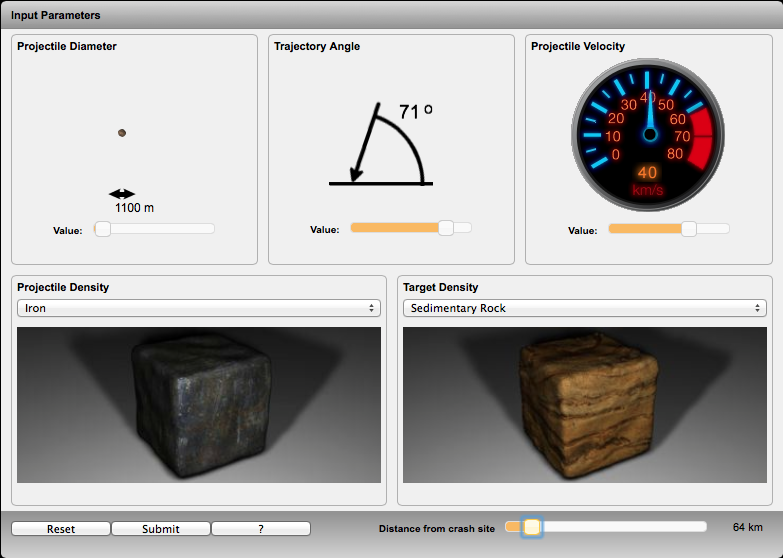
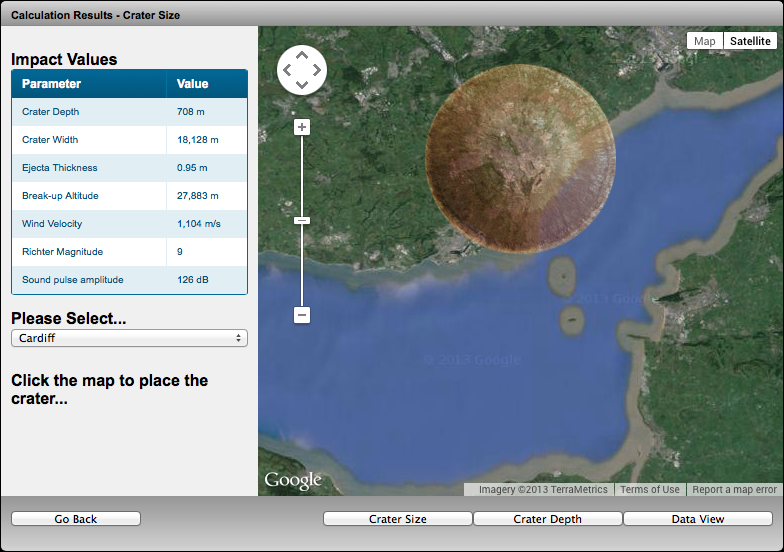
In the example above I chose relatively sedated values for my variables and placed myself at around 64 km from the impact area. Let’s see if I would survive this explosion.
The crater generated by this impact is pretty huge, 18 km in diameter and you can drop your meteorite anywhere you want in the map. Unfortunately what was in the land now occupied by my crater was Cardiff, but at a distance of 64 km (where I placed myself) it looks like I would survive this impact.
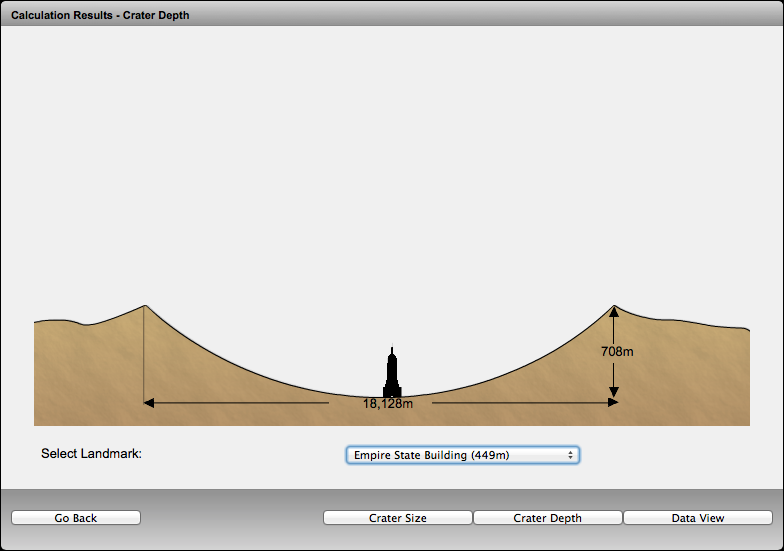
You can then look at the depth of the crater and put famous and tall buildings in the deepest point to get an idea of just how enormous this event would be.
Numeracy Opportunities
The numeracy links are quite obvious with this great simulator. In fact, you can run various trials to see how the diameter of the meteorite would affect the depth of the crater. Indeed you can plot a graph of your results. There are also good links in terms of measuring and units to take into account, but you can also develop some numerical reasoning with this virtual investigation. For example, does the crater’s diameter increase linearly with the speed of the meteorite at impact? What percentage increase in crater’s depth do you get by increasing the meteorite’s angle by 10% each time? Many other opportunities can be explored
Linking traditional with digital
And if you want to develop understanding of scales, you could run your traditional experiment with sand trays and marbles and using their impact crater to scale try to work out the speed of impact of their marbles by looking at the diameter of the marble and their crater. What do they need to take into account here? Can they solve this problem?





Recent Comments